
Updated October 2026
You can build muscle at home if four things are in place: exercises that challenge each major muscle group, a way to make them harder over time (progressive overload), enough weekly sets, and enough recovery, sleep and protein. Equipment matters less than consistency, but adjustable weights make progression much easier once bodyweight moves stop being challenging.
HomeGymUSA may earn a commission when you buy through links on this page, at no extra cost to you. Products are selected from manufacturer specifications; we have not tested them in person.
How muscle growth works, briefly
When you train a muscle hard enough, your body responds by increasing muscle protein synthesis during recovery. Over weeks and months, repeated stimulus plus adequate nutrition and rest leads to larger, stronger muscle fibers (hypertrophy). Two practical consequences follow:

- The stimulus has to keep rising, or your body has no reason to keep adapting.
- Growth happens during recovery, so sleep and rest days are part of the program, not a break from it.
Principle 1: Progressive overload
Progressive overload means gradually increasing the demand on a muscle. The American College of Sports Medicine position stand recommends increasing the load by 2-10% when you can perform the current weight for one to two repetitions more than your target. At home, you can overload in several ways:
- Add reps within a range (for example, 8 to 12) before adding weight.
- Add load with heavier dumbbells, a stiffer band or a weighted backpack.
- Add a set to an exercise.
- Use a harder variation: knee push-up to full push-up to feet-elevated push-up; squat to split squat to rear-foot-elevated split squat.
- Slow the lowering phase to 3 seconds, which increases time under tension when weights are limited.
Write every session down. A simple log of exercise, weight and reps is the easiest way to know when to progress.
Principle 2: Enough effort and volume
How hard each set should be
Research suggests that muscle growth is similar across a wide range of loads as long as sets are taken close to failure. A 2017 meta-analysis found that heavy and light loads produced similar hypertrophy, while heavier loads produced greater strength gains. For home training this is useful: if your dumbbells are light, you can still grow by doing more reps, provided the last few reps are genuinely hard. A practical target is to end most sets with 1-3 reps left in reserve.
How many sets
The ACSM position stand notes that higher-volume, multiple-set programs are recommended for maximizing hypertrophy, with emphasis on the 6-12 repetition range and 1-2 minute rests between sets. A reasonable starting point:
- Beginners: about 6-10 hard sets per muscle group per week
- After 3-6 months: move gradually toward 10-20 sets per muscle group per week if you recover well
How often
The same position stand recommends 2-3 training days per week for novices, rising to 3-4 for intermediate lifters. Training each muscle twice a week makes it easy to spread the volume out.
A sample 3-day home program
Use dumbbells, bands or bodyweight. Rest 60-120 seconds between sets.
| Day | Exercises | Sets x reps |
|---|---|---|
| Day 1 (full body A) | Goblet squat; dumbbell bench press; one-arm row; Romanian deadlift; plank | 3 x 8-12 (plank 3 x 30-45 s) |
| Day 2 (full body B) | Split squat; pull-up or band-assisted pull-up; overhead press; hip thrust; biceps curl | 3 x 8-12 |
| Day 3 (full body C) | Step-up; push-up (progress the variation); chest-supported row on an incline bench; lateral raise; triceps extension | 3 x 10-15 |
Leave a rest day between sessions. For more on choosing between big multi-joint lifts and single-muscle moves, see our guide to compound vs isolation exercises.
Principle 3: Recovery and sleep
- Sleep: the CDC recommends at least 7 hours per night for adults. Short sleep makes hard training feel harder and recovery slower.
- Rest days: give each muscle group at least 48 hours between hard sessions. Our article on why rest days matter covers signs you need more recovery.
- Deloads: every 6-8 weeks, a lighter week (about half the sets) can help joints and motivation.
Principle 4: Protein basics
The recommended dietary allowance for protein is 0.8 grams per kilogram of body weight per day (about 0.36 g per pound), according to Harvard Health. That is the minimum to avoid deficiency, not a target for building muscle. A joint position statement from the ACSM and the Academy of Nutrition and Dietetics on nutrition and athletic performance gives 1.2-2.0 g/kg per day for athletes.
- Example: a 170 lb (77 kg) person would need about 62 g at the RDA, or roughly 92-154 g in the athlete range.
- Spread protein across 3-4 meals rather than one large serving.
- Food first: eggs, dairy, fish, poultry, lean meat, beans, lentils, tofu. Powders are a convenience, not a requirement.
- Eat enough total calories. Building muscle in a large calorie deficit is difficult.
If you have kidney disease or another medical condition, ask your doctor or a registered dietitian before increasing protein.
Lifting technique and safety
- Warm up with 5 minutes of easy movement and 1-2 light sets of your first exercise.
- Keep a neutral spine on squats, hinges and rows, and control the lowering phase.
- Breathe out during the hardest part of the lift. Long breath-holding raises blood pressure; avoid it if you have hypertension or heart disease.
- Use safeties: lift inside a rack with safety arms when using a barbell, and do not train to absolute failure on presses without a spotter or safeties.
Our home gym safety tips cover room setup and equipment checks.
Equipment that helps you progress at home
- Adjustable dumbbells: the BowFlex SelectTech 552 dials from 5 to 52.5 lb per hand, and the PowerBlock Elite EXP starts at 5-50 lb per hand and can be expanded to 70 or 90 lb, which suits lifters who expect to get stronger.
- Adjustable bench: the FLYBIRD adjustable bench covers flat, incline and decline work; compare others in our bench buying guide.
- A rack with a pull-up bar: the HANDBODE squat rack has 32 J-hook positions and a built-in pull-up bar for barbell squats, presses and pull-ups.
- Bands for pull-up assistance: LEEKEY loop bands (8-85 lb) help you work up to full pull-ups.

LEEKEY Resistance Bands Set for Home Workouts
A four-band kit with a carry bag that fits a suitcase, so your workouts can follow you anywhere you go.
Product information
Our review: 4.0 out of 5
Product links
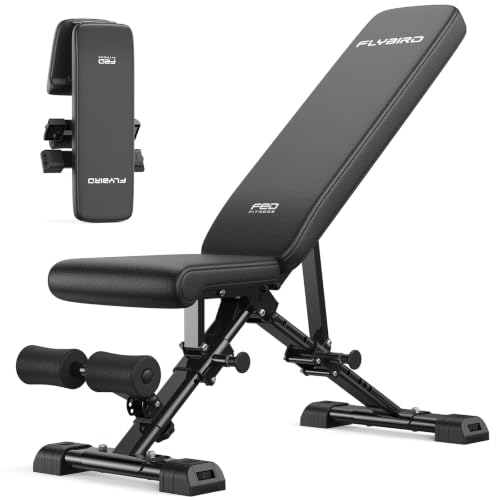
FLYBIRD FB800 Adjustable Weight Bench
A foldable adjustable bench that handles flat, incline, decline and upright positions for workouts at home.
Product information
Our review: 4.5 out of 5
Product links
This article is for general information and is not medical advice. Check with your doctor or a physical therapist before starting a new training program, especially if you have a health condition or injury.
FAQ
How long does it take to see muscle growth?
Strength usually improves within the first few weeks, largely from better coordination. Visible size changes generally take a couple of months of consistent training and eating, and progress varies a lot between individuals.
Can I build muscle with only bodyweight exercises?
Yes, especially as a beginner, if you keep progressing to harder variations and take sets close to failure. Lower-body training is where most people outgrow bodyweight first, which is when dumbbells help.
Should I train to failure on every set?
No. Stopping 1-3 reps short of failure on most sets gives a strong stimulus with less fatigue and lower injury risk. Occasional sets to failure on safe exercises, such as curls or machine-style band work, are fine.
Do I need protein shakes?
No. They are a convenient way to reach a protein target, but meals with eggs, dairy, meat, fish, beans or tofu work just as well.


