
Updated October 2026
Choose based on your goal. For maximum strength, lift heavier weights for fewer reps (roughly 1-6). For muscle size, almost any rep range from about 6 to 30 works if sets end close to failure, with 6-12 being the most practical. For muscular endurance, use lighter weights for more than 15 reps. Most people do best mixing ranges, with the emphasis on the one that matches their main goal.
HomeGymUSA may earn a commission when you buy through links on this page, at no extra cost to you. Products are selected from manufacturer specifications; we have not tested them in person.
The quick answer by goal
| Goal | Reps per set | Load | Rest between sets | Notes |
|---|---|---|---|---|
| Maximal strength | 1-6 | Heavy (about 80% of 1RM or more for experienced lifters) | 2-3+ minutes | Strength is specific: practice heavy lifts to get better at heavy lifts |
| Muscle size (hypertrophy) | 6-12 (up to about 30 works) | Moderate | 1-2 minutes | Total hard sets per week matter most |
| Muscular endurance | 15+ | Light to moderate (about 40-60% of 1RM) | Under 90 seconds | Good for stamina and higher-rep conditioning |
| General fitness / beginners | 8-12 | Moderate (about 60-70% of 1RM) | 1-2 minutes | Safe, effective starting point |
These ranges follow the American College of Sports Medicine position stand on resistance training, which recommends 8-12 repetition loads for novices, heavier loads with longer rests for strength, light to moderate loads (40-60% of 1RM) for more than 15 reps with rests under 90 seconds for muscular endurance, and loads in the 1-12 rep range with emphasis on 6-12 for hypertrophy. "1RM" means the most weight you can lift once with good form; you do not need to test it. A weight you can lift for about 10 good reps is roughly 75% of it.

Why heavier weights build more strength
Strength is partly a skill. Lifting heavy loads trains your nervous system to recruit more muscle fibers at once and coordinate them efficiently. A 2017 meta-analysis comparing low-load and high-load training found that heavy loads produced greater gains in maximal strength. If you want a stronger squat or press, some of your training needs to be heavy.
Practical heavy training at home
- Use stable exercises: squats in a rack, floor or bench presses, Romanian deadlifts, rows.
- Keep 1-2 reps in reserve; grinding out failed reps alone at home is where injuries happen.
- Rest long enough (2-3 minutes) that you can repeat the same quality on the next set.
- Use a rack with safety arms for barbell squats and presses.
Why lighter weights can still build muscle
The same meta-analysis found that muscle growth was similar between low-load and high-load training when sets were performed to or near muscular failure. The muscle cares mostly about how hard the set is, not just the number on the dumbbell. This is good news if your heaviest weights are limited: you can keep growing with 15-25 reps, provided the last few are genuinely difficult.
The trade-offs of very high reps: sets take longer, they are uncomfortable, and it is harder to judge how close to failure you are. For most people, 6-15 reps is the practical middle ground.
How to pick the right weight
- Choose your target range for the exercise (for example, 8-12).
- Pick a weight you think you can lift about 10 times.
- Do the set with good form and note how many more reps you could have done.
- If you could have done more than 3-4 extra reps, it is too light. If you could not reach the bottom of the range, it is too heavy.
- Once you hit the top of the range on all sets, increase the load. The ACSM suggests a 2-10% increase when you exceed your target reps by one or two.
This is called double progression: first add reps, then add weight. It is the simplest way to apply progressive overload, which we cover in more depth in how to build muscle at home.
Combining ranges in one week
You do not need to pick one forever. A simple approach is to put heavier work on compound lifts and higher reps on smaller exercises:
- Squat, press, row, hinge: 3-4 sets of 5-8 reps
- Accessory compound moves (split squats, incline press): 3 sets of 8-12
- Isolation moves (curls, lateral raises, calf raises): 2-3 sets of 12-20
Another option is a heavy day and a lighter, higher-rep day for the same muscles each week. For more on matching exercise type to rep range, see compound vs isolation exercises.
Equipment that makes progression easier
The main limitation of home training is weight jumps that are too big. Five-pound jumps are fine for squats, but on a lateral raise going from 10 to 15 lb is a 50% increase.
- The WLR adjustable dumbbells offer 10 settings from 3 to 25 lb, with small increments for shoulder and arm work.
- The PowerBlock Elite EXP covers 5-50 lb per hand and can be expanded to 70 or 90 lb as your heavier lifts improve.
- The CAP Barbell 52.5 lb adjustable pair uses loose cast iron plates, so you can load each dumbbell in small steps.
- For heavy barbell work, the CAP power rack has adjustable safety catches and a multi-grip pull-up bar.
- A stable bench, such as the compact adjustable bench (ASTM-certified to 827 lb), supports heavy dumbbell presses and rows.
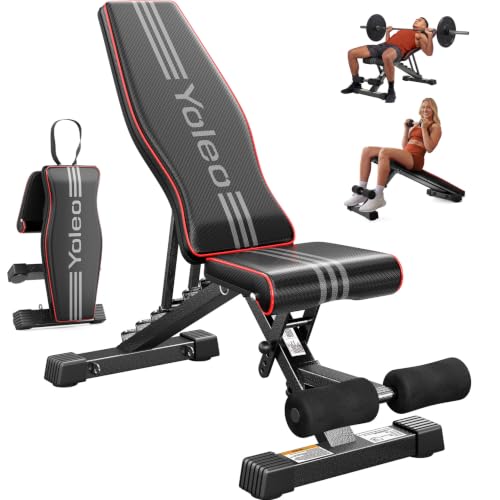
YOLEO Adjustable Compact Weight Bench for Home Workouts
A foldable adjustable bench with 84 positions that tucks under the bed when you are done lifting.
Product information
Our review: 4.5 out of 5
Product links

CAP Barbell 105 lb Adjustable Dumbbell Pair
A plate-loaded pair that swaps weight in seconds so one set covers curls, presses and rows.
Product information
Our review: 3.5 out of 5
Product links
This article is for general information. If you have high blood pressure, heart disease, joint problems or an injury, talk to your doctor or a physical therapist before lifting heavy loads.
FAQ
Is it better to do more reps or more weight to tone up?
"Toning" means building some muscle and reducing body fat. Both rep approaches build muscle if sets are hard enough; fat loss depends mainly on diet and overall activity. Moderate weights for 8-15 reps are a sensible default.
How many sets should I do?
Beginners can start with 2-3 sets per exercise and about 6-10 hard sets per muscle group per week, increasing gradually if recovery allows.
Are high reps safer for my joints?
Lighter loads put less stress on joints per rep, which helps some people with sensitive joints. Very long, fatiguing sets can cause form to break down, though, so stop when technique slips.
Should older adults lift heavy?
Many older adults can safely progress to moderately heavy loads with good technique and supervision at first. Start light, build gradually, and get medical clearance if you have a chronic condition.


